Showing posts with label Lessons. Show all posts

Lesson Plan

For a complete look at the lesson plan curriculum, check this link (click image). 

Objects and Layers

[Objects / Layers]  [Timelines / Sequences]  [Lessons / Exercises]

An Introduction to how to map out your animations.  More illustrations are ahead in the sections.
Objects and Layers are inseparable...  Actually objects are separable only by layer.  Find out what I mean by reading ahead into this area.  By the time you are done with this part of it, you should then be ready to start applying what you know about objects and layers to your timelines and sequences.  

Objects


You're quite capable of imagining your drawings actually moving.  So why go through the hassle of actually performing the great task of copying it into a flipbook?  Because you can. 

That's right.  You should do it just because you're able to, and I'm going to show you just how able you are.  But first, follow me through a series of steps.  Some will seem familiar, others not.  Please concentrate on the areas that seem unfamiliar.  These are probably the points that will help you the most.  

An example of how a computer draws flipbooks
First of all, you should understand that the terms "Object" and "Layer" come from computer programming.  They're terms used when designing animation in certain software (the kind like these people use).  Only for now, I'm applying it to things that you draw on paper.  It works the same way.  

1.  What is an Object?
Section:  Definition of Objects

An "Object" can be just about anything in a flipbook.  Some are more animate than others.  You can draw an object the same for 80 pages, and then flip it, and this will look the same as if you were not flipping the pages.  Why would anybody do this?

So you need to be able to identify objects, as such that they are able to be distinguished.  

2.  Objects can move.
Section:  Motion of Objects

Though it is important to identify that an object is capable of moving, it is also necessary to distinguish whether it moves on its own, something else is causing it to move, or it is merely sitting still and you are the one that's moving.  Each of these characteristics will cause you to understand why things move.  

Because the art of animation is the illustration of intelligence in a seemingly unintelligent world.  While you are sitting there, staring at a notebook, there is something that is triggered by your brain to make you believe or imagine that you're seeing something moving.  

3.  Objects can change chape.
Section:  Morphing

Though it is important to identify that an object is capable of moving, it is also necessary to distinguish whether it moves on its own, something else is causing it to move, or it is merely sitting still and you are the one that's moving.  Each of these characteristics will cause you to understand why things move.  

Because the art of animation is the illustration of intelligence in a seemingly unintelligent world.  While you are sitting there, staring at a notebook, there is something that is triggered by your brain to make you believe or imagine that you're seeing something moving. 


3.  Objects affect eachother.
Section:  Object Dependency. 

Could you imagine the excitement of the people who made the first flipbooks, once they realized that the same effect could probably be achieved with photographs?  Those people knew movies were going to exist, well before they did.  And I wonder if they had any idea what kind of impact it would have on us. 

Let's face it.  The world isn't perfect, and the only reason we have a concept of "perfection" is because we see it in our minds.  Let's find a way to share our personal perfection with eachother, shall we?

So establish an object.  Let's start with a simple one.  A square.  Now picture that square, turning into different shapes.  It could turn into a triangle, or it could split into two separate squares.  You should try this as an exercise.

From the New Yorker

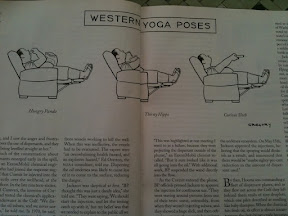
The New Yorker published a cartoon by Gregory and it contained an awesome 3-part illustration, depicting a rather lazy-looking gentleman in a reclinable easychair.


Consider this: your task is to determine, by your own observations, how to animate the illustrated easychair.

First, note the parts that stay the same. Basically the base of the chair. The backrest moves up, the footrest can swing in.

Use your skills and animate a easychair retracting into the unreclined position. think anchor points and other points of connection.

Lesson One: Stickfiguring

Lesson One:  Stickfiguring.
or skip to Lesson 2


We all think that flipbooks are cool.  At least they have lots of potential. 
You have alot of potential.  That's why you're reading this, right?

My goal is to turn your potential artistic energy into something more kinetic.
Flipbooks are sort of like literature, except they require movement to "work."

By "working" they create the illusion of things moving, in such a way that you are willing to believe that you are watching something that has life.  The root for the word life in Ancient Latin is animus.  


Beginner - Intermediate - Advanced
Maybe just a stick figure. 


You might want to start with something simple.  This is a stick figure, and it's a shape that we are all very familiar with.  if you were going to explain a human being to an alien and you had five seconds before it zapped you with a phaser, I suggest you'd draw a stick figure.  

A humanoid form, is its linguistic definition in the Pictorial Dictionary.  I like to keep the proportions of my stick figure the same.  That way it keeps its shape.  In very small humanoids, I like the head and the body to take up about the same amount of space.  However, in larger humans, the space is divided into thirds, with a head, torso, and legs (as well as limbs, see breakdancing robot).  

The humanoid is the foundational framework on which you will build your actual cartoons.  All you need now is to "dress up" the humanoid as a more characterized being, with detail.

Turning Stickfigures into Characters

Then, you can take a stick figure, and just add more detail to the parts to make it not just a vector graphic, but a full-out shape that people can recognize and you can identify as a "character."

It's important that you characterize your drawings with names for them which correspond with their distinguishing characteristics.  

Sequence Pages

The page above is an example of a Layout Page, and that's something you draw on a single, large-sized piece of paper which maps out all of the ways that certain things will change.  As you can see from the layout page above, all of the objects in the flipbook have been mapped out.  It shows you how the circle for the head of the stickfigure turns into a space ship.  Then it describes how the rest of the body, meaning the limbs, turn into a tree.  It really helps, when making flipbooks, to have a layout page, and you can see some other examples of that [here (link to layout pages].

Exercise 1.  Draw a Humanoid Flipbook.
It might cost you a brunch, in supplies.  Yes, brunch.
So if you want me to draw it for you, you can buy it from me for $5. 
As soon as I get the printing press to work again. 

Otherwise, you can use the index margin of an old book you find at a tag sale or a used book store.  Never mind the content, if it's uninteresting; or you might use the contents as inspiration.  Perhaps you could illustrate a scene from your favorite Shakespearian play?  

If drama isn't your specialty, then maybe you can get a book on taxidermy and learn how to animate that.  I went to a taxidermatologist once and the experience was not a very good one.  My skin looks great but it costed me 35% of everything i own.  

Here are some additional helpful pointers and hints. 


"Animus" in Latin means "Life."
Give some life to your drawings!
You can animate Romans, if you'd like.  
They're the ones who came up with Latin.  


Continue to Lesson 2


This was composed by a real Solar Electrical Installer.
5kw.  3 Days.  BroadBrook, CT (2008).  LineLoad.Org


Timelines / Sequences

[Objects / Layers]  [Timelines / Sequences]  [Lessons / Exercises]

An Introduction to how to map out your animations 

You can only imagine what it must feel like, for a circle to split and become two circles.  Ouch.  
Or can you guess what a deep and significant feeling it might be, to be a tree and grow?

If you can imagine or guess any of these things, then you can grasp the next concept I'm about to describe. Flipbooks can help you organize your imagination.  By mapping out the details of what you want to see over the course of a timeline, by plotting a sequence with specific events to occur at precise page #'s (moments), you can create something that is totally intense and beyond words incredible, so please post with your YouTube videos in the comments below.  I always appreciate that.

A timeline is like an itinerary of sorts for flipbooks.  If you were drawing a flipbook of a train, for example, and you were working in a Rhodia notebook that was exactly 80 pages, you would know that if you wanted the train to make 4 stops, it would be a bit rushed if you made each stop exactly 20 pages a piece.  You end up rounding off all the stops such that maybe there'd be a 10 page intro, then an average of about 15 pages per stop will get you at around page 70, just in time for a 10 page outro. 

That's how my brain calculates pages, and yours can, too.  What made this process much simpler was that I was able to consider that by mapping it out on a single sheet of paper, you can really get into having expectations, when it came to the final outcome of a flipbook.  

Think of it this way:  it's bad enough that you can't copy and paste images on paper in real life with the same amount of ease that a computer can.  But that doesn't mean that you should cave in and just start browsing the internet again.  Get back out there with your pen and try again, my friend.  Timelines save valuable energy, by helping you to not make mistakes.  What also helps?  Try not ever using pencil.  It's a waste of time to rely on the fact that you can erase something.  When you can't erase, you make less mistakes.  I know it sounds very zen, but I'm trying to share with you my creative process here so give me a break.  I'll give you a break from my words and put up a picture. 


Here is an example of a timeline.  As you can see, there are different events which take place.  You know which flipbook this is, right?  Click here if you want to watch it real quick.

Timelines are great, but you'll notice there's a terminology called "morph."  If you look really closely, somewhere between 20 and 40, the yellow thing morphs from being boxy to being circular.  Also, noteworthy is that the other blob at 40 becomes purple at 60.  I'm not sure what "run title" means.

Anyway, so that's what a timeline looks like.  I'm sure you can come up with hundreds on your own.  Just remember, that timelines and sequences go hand in hand.  They work together like a point guard and a forward should.  With synergy.  Wade and James could stand to use a lesson from the Dunka.

Did you know that Alex English was the top scorer in the NBA during the 1980's? 

Sequences : Timelines Without Numbers


Timelines / Sequences


[Timelines / Sequences] 
[Objects / Layers]  [Timelines / Sequences]  [Lessons / Exercises]

An Introduction to how to map out your animations 

You can only imagine what it must feel like, for a circle to split and become two circles.  Ouch.  
Or can you guess what a deep and significant feeling it might be, to be a tree and grow?

If you can imagine or guess any of these things, then you can grasp the next concept I'm about to describe. Flipbooks can help you organize your imagination.  By mapping out the details of what you want to see over the course of a timeline, by plotting a sequence with specific events to occur at precise page #'s (moments), you can create something that is totally intense and beyond words incredible, so please post with your YouTube videos in the comments below.  I always appreciate that.  

A timeline is like an itinerary of sorts for flipbooks.  If you were drawing a flipbook of a train, for example, and you were working in a Rhodia notebook that was exactly 80 pages, you would know that if you wanted the train to make 4 stops, it would be a bit rushed if you made each stop exactly 20 pages a piece.  You end up rounding off all the stops such that maybe there'd be a 10 page intro, then an average of about 15 pages per stop will get you at around page 70, just in time for a 10 page outro. 

That's how my brain calculates pages, and yours can, too.  What made this process much simpler was that I was able to consider that by mapping it out on a single sheet of paper, you can really get into having expectations, when it came to the final outcome of a flipbook.  

Think of it this way:  it's bad enough that you can't copy and paste images on paper in real life with the same amount of ease that a computer can.  But that doesn't mean that you should cave in and just start browsing the internet again.  Get back out there with your pen and try again, my friend.  Timelines save valuable energy, by helping you to not make mistakes.  What also helps?  Try not ever using pencil.  It's a waste of time to rely on the fact that you can erase something.  When you can't erase, you make less mistakes.  I know it sounds very zen, but I'm trying to share with you my creative process here so give me a break.  I'll give you a break from my words and put up a picture. 


Example: Breakdancing Bot

back to [examples]
A conceptual drawing for the Dancin' Bot

Example: Turtle on a Bicycle


back to [examples]

See also:  Rolling Hills (link: coming soon).  

This is a Turtle on a Bicycle.  You can draw your own.  Here are the elements that were used in the construction of this flipbook.  I didn't use a computer.  There were no special techniques.  

You are as good as a computer.  Your mind is more powerful than any computer in the world.
Don't believe me?  Prove it to yourself!  Just try to build your own flipbook, using Ralph as a lesson.

Ralph is a turtle.  He is slow.  But you can make everything appear to go faster, because you control the pages.  When you take away the motion, Ralph is on every page.  He has a body and a helmet and a shell.  It's all good if you have a helmet.  

You are going to need some pens and markers.  Click [tools] at the top to order, and check below at the image to determine what Prismacolors you need to buy.


Maybe you have a difficult time drawing the hills.  You could take the easy route, and just buy a "Rolling Hills" flipbook, one with things partially drawn for you.  

Or you could try to learn how to draw it yourself.  
That will teach you how to animate waveforms. 
(might also cost you a couple books in mistakes...  practice in margins).


Topics


An Introduction


Much of the guide was transcribed by things that I learned from talking to the Dunkasaurus.
As you might note, however, the Dunkasaurus is an imaginary character that I invented, so in all actuality, I taught myself flipbooks and all these techniques by familiarizing myself with the Dunka through a series of trial and error.


The flipbook which helped me out the most, in terms of learning skills that were easily applied to others, was the Turtle On A Bicycle. I thought it was soo cool, the first one that I made. I got in line at the Yale Bookstore and went up to Ralph Nader at a book signing and gave him it, because I thought it was kind of crazy that he was running for President of the United States, and was actually being mentioned in the national news as having at least a calculable percentage of approval points, but his political party didn't even have an animal mascot. So I offered him the idea that since slow and steady won the race for our green friend, the turtle, it might also work for him (or other Green Party candidates in the future).

I've never taken a class on drawing. I just kind of fudged around in my notebooks in high school and found that doodling was actually helpful. In fact, pretty much my entire graphic style, like many others who discovered the same, had been derived from illustrating my note-taking in high school. Later on, I went to home-school myself through college and became a self-taught illustrator, animator, web designer, musician, and whatever else it was that I felt like doing and getting better at.

In the process, I worked at bookstores, movie theaters, and coffeeshops. Then, I found jobs working on farms and for community gardening programs. I even got a job as a solar electrical technician, and became a lead installer.

Not to say that I am amazing at all of those things. I still have much to learn, when it comes to many of the things that I taught myself. In the process of delving into these subjects with no guidance or instruction, I simply tried lots of different approaches, and then documented the ways that actually made my styles improve. This led to a series of instructional guides I wrote, which came from some kind of internal desire to share what I learned. In knowing that I am self-taught, it saves me the hassle of siting references, since there aren't any, and it renders me immune to plagarism. I didn't read a single book on animating. I never took a class on it, or studied the works or techniques of other animators.

That doesn't qualify me to consider myself to be the best at flipbooking, because I've seen many out there that contain skills that I don't have. It does, however, put me in a place that I have called "Flipbook Island."

Non-Animated Books That Relate To These Flipbooks

The skateboarding flipbooks work with "Skateboard Music" (another title in the series)


Flipbook Island is a place in your mind that you can go to, where everything is a cartoon and most of it is in primary colors. Anything that happens on that island is conceived by humankind in the form of hand-drawn flippers, neatly bound in little orange notepads. Yes, I want to start a movement, not just within the pages of these little notebooks. Indeed, this is about getting away from computers a little bit.


But it's also about having skills that no one else has, which people want. I don't believe that people just want a dunking basketball dinosaur. If it were me, and I walked into a store and saw that, I would definitely think it was cool, but I would hope that an ambitious individual would see it as a challenge to create their own in a similar style and quality. The Instruction Manual is intended to help with that.

The main techniques described in the guide are the concepts of timelining, object/layer, and sequences. If you can get a grasp on what I mean by those terms, your flipbooking skills will increase exponentially.

The musical themed flipbooks work with MIDI language.
This is descibed in more detail with the title "Audiomatic Expressions"


If you're too young to understand the language in the book, just look at the pictures and you will understand what the words are trying to explain. When you get older, maybe you can read the book again in 5 years and the words might make more sense, and you might understand the concepts in a little more detail. It's still written to help improve your skills at any level, for people of all ages.

The animation skills require the use of a graphic design style which I've also constructed around my explaining process, called Analog Basic. To put it simply, everything you can draw with a pen (each line, connected to other lines), is a geometric shape. Those geometric shapes need to stay consistent throughout the course of a flipbook anyway, in order to maintain the identity of the image. It's basically a very 2D style, but it's a great platform to learn from, and you can give it 3D characteristics but it looks and works like a 8-bit or 16-bit videogame.

Making those shapes move and work together can be difficult, but there are lots of ways to make it simpler. They're all listed within the text of Flipbook Island's Guide to Flippers, narrated by Dunkasaurus Rex.

You can teach this in classrooms if you want. If they taught this stuff in high school, maybe I would have payed attention. Kid Analog is where books meet computers on a whole new level.

Taking sides (and choosing books),
Kid Analog (Ian Applegate)


coming soon


Next Title: Learn How To Sequence Literature!
Sorry4Graffiti.Com


The How-To Guide on Flipbooks


This is how I recommend you teach yourself flipbooks.  It takes time to get really good at it, and that's the message behind Pre-Step 1.   The other thing is there is no such thing as "art skills."  It's a matter of trying to succeed your result.  If your purpose is to convey an idea, your "art."


Language is not confined to words.  We see pictures everyday.  We recognize objects like the signs on the highway.  We can identify shapes.  In life, we piece together words that are symbols.  They help us perceptualize the world.  When you see a cartoon, what do you see?

You see lines, that are connected by other lines.  Each one of those lines had to be drawn.  Then, they're colored in.  What you don't see with every cartoon that you see on the television and internet, is the way that the cartoon was put together.  I'm going to show you, line by line, how I draw mine.  And from there, if you care, you can draw your own and put together some great stuff to share with your friends and family.

Aside from this .TXT, you will find a ton of "JPG's" because:
A BPM's worth a thousand TXT's.  (A picture is worth a thousand words) [1996]

Make time to draw


The first thing you need to make awesome cartoons is the time to draw.  Many people out there say that there's no time for drawing, but we make time for things like television and videogames, which ultimately will not benefit you.  Imagine if you drew a flipbook about baseball, and it took you just as long to watch a baseball game on TV.  Wouldn't that be an awesome use of time?  You could even have the game on in the background, to provide inspiration.

You have to make time to draw.  If you're in class, and the teacher is speaking about something, does it bother that teacher if you're doodling?  Probably does a little bit if you're supposed to be paying attention.  So why not doodle about what the lesson is about?  It gets your mind focused on the subject matter, and you're also employing your drawing skills.  Do words really help that much?

Also, think about the difference between words and a picture.  This is the lesson of the Rule of Lines.  I challenge you to just draw a little bit more often.  Make time for it, or do it while you're doing other things, like sitting in class or watching TV.  It'll really help you out, because there's nothing worth stressing like expressing yourself.  And nothing is more moving than the movie you are living. 


So make a cartoon about your life.  Draw something that expresses your feelings.  Make time to draw.

Yes, you must explore.  This is a key step in the process of these various different endeavors.  

Many of us are content to simply consume the imaginative products of others.  Our own thoughts become byproducts of others' imaginations.  There is a powerful magic and it's called TV.  What makes it magic?  Masses watch it.  Only a few actually make it.  

You must explore your imagination a little.  Get into what you think about.  If your mind is negative, or you are pessimistic, you will have no luck with this at first.  The best way to get out of a negative or pessimistic state is to follow lesson 2, because it will get you out of there.  


Yes, there are rules to this game, and if you want to win, you have to play by them.  You can't win the game if you don't play by the rules, and if you're going to throw away pages, then you'll also want to keep starting from scratch.  In other words, you're not going to get very far if you start tossing away frames.  Keep trying to get a perfect one that's exactly 80 pages.

In that regard, the flipbooks are like haiku.  Those are poems that contain a certain number of syllables per line.  It's the structure of the format that gives the poem its identity.  That's what makes an Analog Flipbook (my method of making hand-drawn animations) what it is.


An "Analog Flipbook" is, by definition, an 80-page sequence composed only of pen and ink, in a notebook of graph paper.  If you want to get more specific, it happens to also contain the methods of drawing ascribed in this text.  If you follow the Analog path, it will take you down the same road that it's brought me.  That means you'll be able to draw awesome flipbooks.

If you would like to order parts to build an Analog Flipbook, head on over to [tools].  In the meantime, keep reading and discover what you can do with those tools. 

Once you're ready to explore, build on the ideas that interest you the most.  Try to imagine pictures in your mind.  Keep the first ones very simple.  And then start developing timelines, which will help you draw great animation sequences.  


Main Article [link] contains illustrations

A timeline helps you understand what will happen over the course of an entire flipbook.  It lists the total number of pages in the sequence (with the recommended "Rhodia" pads, that's a timeline of 80 pages, assuming that you follow rule #1).

Timelines can be any length of pages, but to understand timelines, you have to be able to keep a schedule.  If you can say that on page 60, there will be a change in the color of the ghost, then you know that you have followed your own instructions, and the book will appear correctly.
Trust yourself and you can make one just as cool as [this].

So, when you're drawing, learn about timelines because they can really help you out.  Here's a close-up of the first videogame flipbook.
Titles:  See "Words."


Once you have grasped the ability to create a timeline, learn how to draw "Sequences."
A sequence does not necessarily contain the information of what happens at which points in time, although on this particular page, we see both that information.  Read about Concept 2.


Twister, a very good example of a sequence 
Sequences are how you can establish what is going to happen, and what it's going to look like.  Remember that timelining is just an outline of when things are going to happen.  

You can base how you think things will appear by researching about it.  I had a to watch a couple videos on tornados on Youtube before I could finally put this one together.  This one was about a cloud, and it becomes a tornado.  I had to really imagine what a real tornado would look like.  Later, I added Jeb and Billy to escape from it in their Orange Truck.  You can escape a twister, but the best thing to do is prepare.  You can prepare for a twister by drawing your own tornado flipbook.  Maybe it might look like mine.  Possibly some of the houses will not look the same.  Maybe there will be different kinds of trees.  Just remember you're welcome to use my stuff.  I have left it all out for you on this internet table to make your own cartoons with.  

Now we're actually getting into drawing.    It's time to talk about objects


An object is any recognizable shape.  In order for two images on consecutive pages to appear to be the same object, they must look the same.

Main Article [link] contains illustrations

An object is any recognizable shape.  In order for two images on consecutive pages to appear to be the same object, they must look the same.  "Objects" is a way of drawing pictures of nouns (persons, places, or things) in a way that keeps those shapes recognizable for a series of pages.  In order for your brain to recognize a shape as an "object," it must be able to identify it.  A simple example of an easily identifiable object is a square, or a rectangle.

Rectangles are shapes that are four-cornered, but they are longer than squares in one dimension.  You can change a square into a rectangle by altering the lengths of the dimension.  If you alter the length of one side, the other side has to be the same length.  In that sense, you wind up drawing the lines in groups of 2, which parallel each other and intersect with the same line.

When you have nothing really to do, don't be afraid and go outside by yourself at night.  Look up at the sky and look at all the stars.  Imagine what it must feel like, to travel from star to star.  That's how I learned how to draw flipbooks.  The pages will scroll.  Give yourself a chance.

Main article [link] contains illustrations

If an object is moving at the same pace, that's known as scrolling.  In other words, you might have one where a skateboarder is doing tricks.  The lamp-posts, fire hydrants, and buildings in the background scenery all move from right to left, as it appears that the skater is moving forward to the right.  Meanwhile the skateboarder stays centered in the middle of the page throughout the sequence.  

That's the concept of the sub-topic of scrolling.  Each of those objects are moving at the same pace, in a similar direction.  When only some objects scroll, it gives the appearance that the other objects that aren't scrolling are in motion.  You can use that technique in a whole bunch of different ways, including morphing.


Main article [link] contains illustrations

An object in a flipbook, unlike that of a static image, can morph into another shape that can also be identifiable.  Flash calls that "shape tweening."  I call it "object morphing."  Same difference.

Morphing is one of those techniques that takes time to understand.


Layering is one of the core concepts of hand-drawn animation.  If you draw the wrong thing first, it will block the other objects on the screen.  That's just the way it works, which can become especially difficult if you decide to play by rule #2


If you really grasp the concept #3 on layering, you will really be able to develop a strong ability to not need to erase anything.  Meaning that if you establish, well in advance, the chronological order in which you draw things, then it will become quite easy for you to build upon a drawing, once it's been started.

now back to 
Layering is actually the chronological order in which you draw your flipbook.